
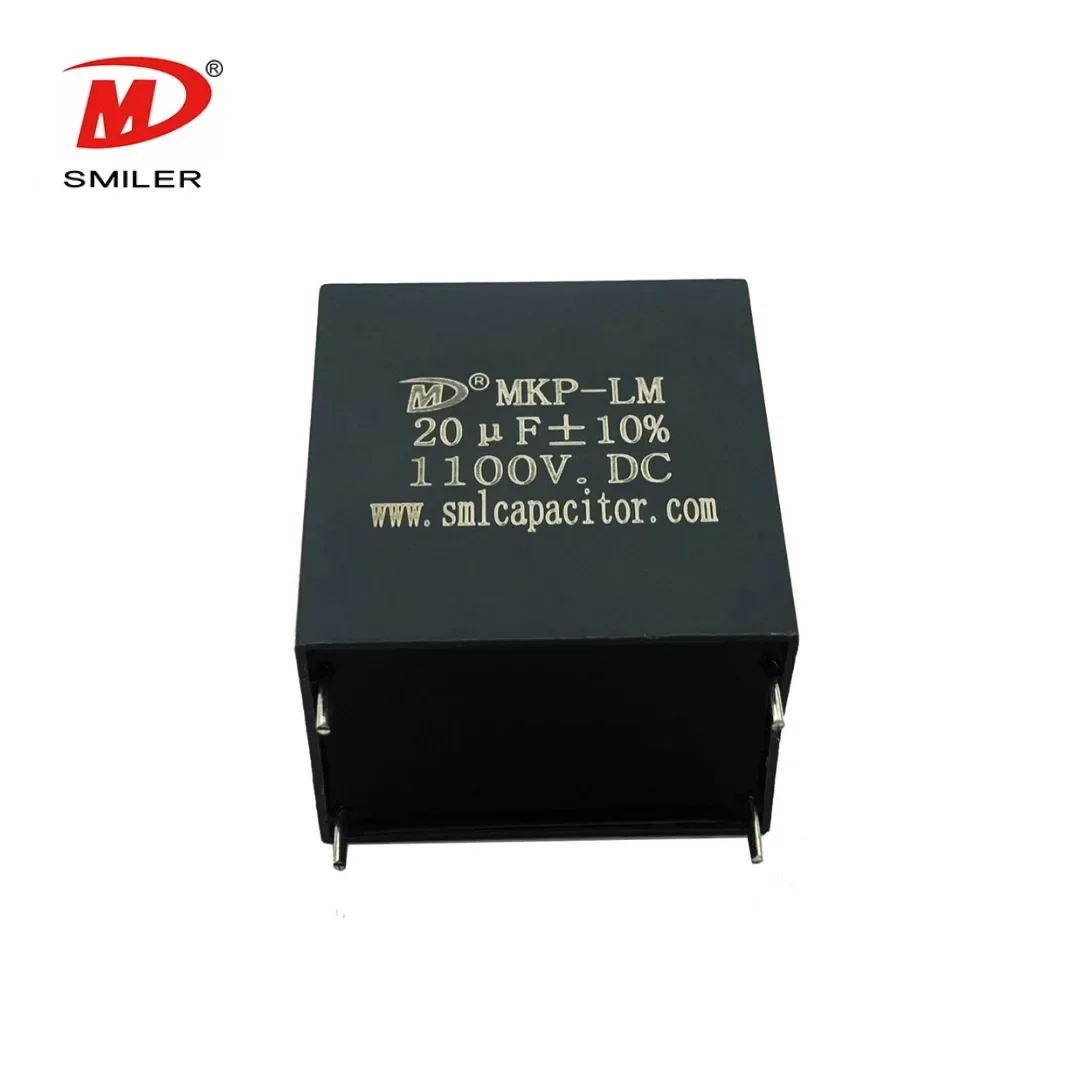
Outdoor PV inverters and coastal energy storage cabinets share one brutal operating condition: sustained humidity at elevated temperature while the DC bus stays energized. That combination—temperature, humidity, bias, or thb—is the failure mode that quietly erodes DC-link capacitor life. Standard plastic-housed film capacitors often survive the datasheet numbers but degrade in the field, because moisture reaches the metallized film and corrodes the electrode layer under voltage. SMILER's MKP-LM THB-Type addresses this with a PPS housing, passing 1000 hours at 85°C / 85% RH with bias while holding |ΔC/C| ≤ 10%. Here's what actually happens inside the can, and why housing material is the difference between a five-year capacitor and a fifteen-year one.
The Physics of Moisture-Driven Metallization Corrosion
Metallized polypropylene film works because a nanometer-thin aluminum or zinc-aluminum layer sits on a polypropylene dielectric. That metal layer is the electrode. It's also the weakest link under humidity. Water molecules diffuse through the polymer film, through micro-gaps at the film margin, and along the end-spray contact zone. Once moisture reaches the metallization, an electrochemical cell forms—especially when the capacitor is biased. The positive electrode oxidizes; the metal converts to oxide and hydroxide; capacitance drops as the effective electrode area shrinks.
The bias matters enormously. An unbiased capacitor in a humidity chamber can look fine for months. Apply rated DC voltage and the corrosion front accelerates, because the electric field drives ion migration and the local electrochemistry has a driving potential. This is why IEC 60068-based damp-heat tests for DC-link capacitors specify bias voltage—the test is meaningless without it. Say a 100kW string inverter running at 1000V DC bus in a coastal installation: the capacitor sees continuous bias, ambient swings between 30°C and 60°C, and relative humidity inside the enclosure can sit above 80% for weeks. That's the real-world THB profile.
Capacitance loss is the first symptom. ESR rise follows as contact resistance at the spray ends increases. In severe cases, self-healing events cluster and puncture sites accumulate, ending in insulation resistance collapse. The failure isn't sudden—it's a slow drift that shows up as increased ripple voltage, higher hot-spot temperature, and eventually inverter derating or trip.
Why Standard PBT and Epoxy Housings Fall Short
Most PCB-mount DC-link capacitors use PBT (polybutylene terephthalate) housings with epoxy potting. PBT is a fine engineering plastic for dry environments—it's dimensionally stable, flame-retardant grades meet UL94 V-0, and it's cost-effective. But PBT is hygroscopic. It absorbs moisture from ambient air, and at 85°C / 85% RH the absorption rate climbs. The absorbed water doesn't stay in the plastic; it migrates inward toward the film element. Epoxy potting helps, but epoxy is also permeable to water vapor over long exposures, and the potting-to-housing interface is a diffusion path.
There's a second problem: CTE mismatch. PBT expands more than the film element under thermal cycling, and repeated 85°C excursions combined with moisture swelling can open micro-cracks at the potting boundary. Once a crack forms, moisture ingress accelerates locally. You won't see it in a 168-hour qualification; you'll see it after 500 to 1000 hours, which is exactly where standard parts start drifting past ±5% capacitance.
Epoxy alone isn't the villain—it's the combination of a moisture-absorbing housing, a permeable encapsulant, and continuous bias. Change the housing to a low-absorption polymer and the diffusion path narrows dramatically.
PPS Housing: The Material Argument
Polyphenylene sulfide (PPS) is semi-crystalline, and its water absorption is among the lowest of any engineering thermoplastic—roughly an order of magnitude below PBT in saturated conditions. At 85°C / 85% RH, a PPS housing absorbs very little moisture, so the driving force for inward diffusion drops. PPS also holds its mechanical properties at elevated temperature, so the housing-to-potting interface stays stable through thermal cycling. Less swelling means fewer micro-cracks. Fewer micro-cracks mean fewer moisture highways.
SMILER's MKP-LM THB-Type uses exactly this approach: metallized polypropylene film, a PPS high-temperature housing, UL94 V-0 flame-retardant construction, and epoxy encapsulation, with 2/4/6-pin PCB mounting. The series covers 500V to 1200V DC and 1µF to 110µF, with 50,000-hour life at rated voltage and 85°C. The THB qualification is the headline: 1000 hours at 85°C / 85% RH with rated voltage applied, |ΔC/C| ≤ 10%. That's not a marketing number—it's a biased damp-heat endurance result aligned with IEC 60068 test methodology and the GB/T 17702-2021 (IEC 61071:2007) framework for DC-link capacitors.
For design engineers, the practical takeaway is simple. If your inverter or PCS sits in an enclosure that sees condensation, coastal salt-humidity, or monsoon-season cycling, the housing material is a reliability parameter, not a packaging detail. You can review the full MKP-LM THB-Type PPS DC-link series specifications for voltage, capacitance, and pin configurations.
Specification Comparison: Standard vs THB-Type DC-Link Capacitors
The table below compares SMILER's PCB-mount DC-link families. The standard MKP-LM suits controlled-environment designs; the THB-Type is built for the humid, biased conditions that dominate outdoor PV and coastal ESS.
| Parameter | MKP-LM (Standard) | MKP-LM THB-Type (PPS) |
|---|---|---|
| Housing material | Flame-retardant plastic, epoxy potted | PPS high-temperature housing, epoxy potted |
| Dielectric | Metallized polypropylene film | Metallized polypropylene film |
| Voltage range | 500–1200V DC | 500–1200V DC |
| Capacitance range | 1–110µF | 1–110µF |
| Mounting | 2/4/6-pin PCB, potted | 2/4/6-pin PCB, potted |
| Flame rating | UL94 V-0 | UL94 V-0 |
| Damp-heat biased test | Standard qualification | 1000h @ 85°C / 85% RH with VR, |ΔC/C| ≤ 10% |
| Life at rated voltage | 50,000h @ 85°C | 50,000h @ 85°C |
| Reference standards | GB/T 17702 (IEC 61071) | GB/T 17702-2021 (IEC 61071:2007); IEC 60068 |
If your design uses a lower-voltage PCB-mount DC link and you want to compare footprints, the MKP-LM PCB DC-link capacitor page lists the standard series dimensions and pinouts.
Design Guidance for Outdoor PV and Coastal ESS
Housing material solves part of the problem. Layout and thermal design solve the rest. Keep the capacitor away from the hottest switch-mode devices—every 10°C reduction in hot-spot temperature roughly doubles film capacitor life, and that rule compounds with humidity derating. Ensure the enclosure has a controlled condensation path; a sealed cabinet that breathes through a Gore vent behaves very differently from one that cycles humid air across the PCB. If you're specifying a 1100V or 1200V DC bus for a 100kW-class string inverter, choose the THB-Type and verify the pin configuration against your busbar geometry early.
For coastal ESS cabinets, salt fog adds chloride ions to the humidity mix, and chloride accelerates aluminum metallization corrosion. PPS housing won't stop salt fog from reaching exposed terminals, so conformal coating or terminal shrouds still matter. But the film element stays drier, and that's where capacitance stability lives. You can find more on humidity derating and test methodology in SMILER's engineering resources.
One more practical point: don't assume a standard part plus conformal coat equals a THB part. Coating protects the PCB side; it doesn't change the housing's moisture absorption. The diffusion path runs through the plastic, not across the board.
Frequently Asked Questions
What does the 1000h @ 85°C / 85% RH rating actually verify?
It verifies biased damp-heat endurance: the capacitor is held at 85°C and 85% relative humidity with rated DC voltage applied for 1000 hours, and capacitance change must stay within |ΔC/C| ≤ 10%. Bias is essential—without voltage, the electrochemical corrosion mechanism that limits field life doesn't develop.
Can I use the standard MKP-LM in an outdoor inverter if I add potting or coating?
External potting or conformal coating protects the assembly but doesn't change the housing's moisture absorption. The dominant diffusion path is through the housing material itself. For sustained humidity with bias, specify the PPS-housed THB-Type rather than relying on secondary protection.
Does the THB-Type change my electrical performance?
No. The MKP-LM THB-Type keeps the same metallized polypropylene dielectric, 500–1200V DC range, 1–110µF capacitance range, 2/4/6-pin PCB mounting, UL94 V-0 flame rating, and 50,000-hour life at rated voltage and 85°C. The difference is the PPS housing and the verified biased damp-heat endurance it enables.
Related Capacitor Series
Need Datasheets or Custom OEM Film Capacitors?
Send your capacitance, voltage rating, and mechanical drawing. Our 9-member engineering team replies within 24 hours with 5-day prototyping availability.